

AI Strategy& Consultancy

AI IS NOT THE FUTURE OF MARKETING. IT IS THE PRESENT.

We help brands understand, adopt, and operationalise AI as a capability to build.

Artificial intelligence is reshaping every part of the marketing function, informing how audiences are identified, how content is created, how campaigns are optimised, how customer journeys are personalised, and how decisions are made. The brands that are integrating AI thoughtfully and systematically are moving faster, spending more efficiently, and building competitive advantages. We help brands get there, with clarity, without the noise, and with a strategy that is built around their specific business, not a generic playbook.

We work with founders and marketing leaders who know AI matters but are not sure where to start, with teams that have begun experimenting but lack a coherent framework, and with businesses that are ready to operationalise AI across their marketing function at scale. Whatever the starting point, the approach is the same: understand the business first, identify where AI creates the most leverage, and build towards it with discipline and a clear measure of success.

THE APPROACH

We cut through the noise and find what actually works for your business.

The AI landscape is loud. Every week brings a new tool, a new capability, a new claim about what it can replace or transform. For most marketing teams, the challenge is not awareness; it is knowing what to adopt, in what order, at what cost, and with what expectation.

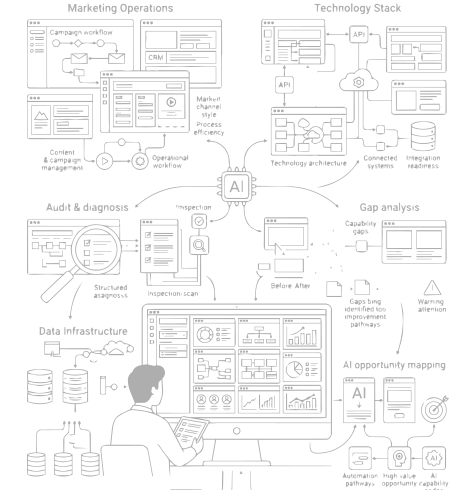
We bring a structured, business-first approach to AI strategy. We start by understanding the marketing function as it currently operates—the workflows, bottlenecks, data, tools, and team. From there, we identify where AI integration creates the most meaningful leverage: reducing cost, increasing speed, improving personalisation, or sharpening decision-making. The result is not a list of tools to subscribe to. It is a roadmap built around your business, your capabilities, and your goals. 

WHAT WE DO

SIX CAPABILITIES. AI THAT WORKS FOR YOUR BUSINESS.

Case Studies

Real work we've put to flight

Web Development & Web Technologies

Enhancing Stratasys' Leads by 51%: Synergos' Effective Lead Generation Strategies

Stratasys is a leading American-Israeli manufacturer of 3D printers, software, and materials for polymer additive manufacturing.

2026-04-27
Web Development & Web Technologies

Mindtree

How Synergos’ Search Engine Optimisation (SEO) Strategies Rehabilitated MindTree Ltd’s Website Performance

2026-04-27
Capabilities at a glance

Expertise crafted from experience

Audit & Readiness Assessment
AI Marketing Strategy & Roadmap
Content & Creative AI
Marketing Automation & Personalisation
Audience Intelligence & Targeting
AI-Powered Analytics & Forecasting
Tool Selection & Implementation
Team Training & Capability Building
Frequently Asked Questions

The answers you're looking for

Entirely. AI is already embedded in the tools most marketing teams use every day, from ad platform optimisation to email personalisation. The question is not whether AI is relevant to your marketing. It is whether you are using it deliberately or letting it work in the background without strategic direction.

Not necessarily. Some of the most impactful AI applications in marketing work effectively with relatively modest data sets. We assess your current data infrastructure as part of the readiness audit and recommend AI applications that are appropriate for where you actually are.

No, and we are direct about this. AI replaces tasks, not judgement. It accelerates production, surfaces patterns in data, and automates repetitive processes. The strategic thinking, the creative direction, the relationship management, and the brand decisions still require people. What AI does is free those people from the work that does not require them, so they can focus on the work that does.

By building adoption into the implementation plan, not treating it as a footnote. We design workflows around the tools, train the team that will use them, and stay involved through the early adoption period to troubleshoot and adjust.

The initial audit and roadmap typically takes three to four weeks. Implementation timelines depend on the scope: a focused automation project might take six to eight weeks; a broader, multi-function integration programme can run over several months. We phase the roadmap so value is delivered progressively, not only at the end.

Yes, after the audit. Tool recommendations are only useful once we understand your stack, your workflows, your team's capabilities, and your budget. Recommending tools before that groundwork is done is how businesses end up with expensive subscriptions they do not fully use.